
From Policy to Implementation: ECESP Launches Its 2026–2028 Work Programme
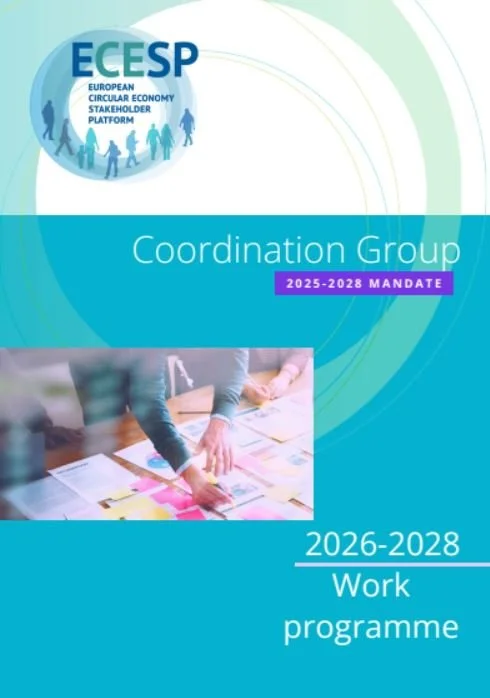
The European Circular Economy Stakeholder Platform (ECESP) has officially adopted its Work Programme for the 2026–2028 mandate, under the leadership of Ladeja Godina Košir, who continues her role as Chair of the ECESP Coordination Group.
As highlighted in her foreword, Ladeja emphasises that the circular economy is no longer a standalone environmental agenda, but a strategic framework for Europe’s competitiveness, resilience and social cohesion.In a time of geopolitical uncertainty, climate pressures and growing resource dependencies, accelerating circular transformation is about safeguarding long-term prosperity and reinforcing European values of solidarity, fairness and responsibility.
Four strategic priorities for 2026–2028
The new work programme is structured around four overarching priorities:
Translating EU circular policies into practical implementation pathways
Accelerating the deployment of an integrated circular bioeconomy
Strengthening the single market for secondary raw materials
Reinforcing stakeholder networks, peer learning and citizen engagement
These priorities respond directly to upcoming EU policy developments, including the forthcoming Circular Economy Act, while ensuring stronger alignment between policy ambition and implementation on the ground
Five Leadership Groups driving implementation
To operationalise the strategy, five interconnected Leadership Groups (LGs) will guide the work of the platform:
LG1 – Transitioning to circular value chains
Focused on strengthening collaboration across sectors such as critical raw materials, plastics, textiles and the built environment. The group will support reuse, repair, remanufacturing, reverse logistics and industrial symbiosis, with particular attention to SMEs ECESPprogram.
LG2 – Advancing an integrated circular bioeconomy
Dedicated to scaling regenerative and biobased solutions across agriculture, forestry, food and biomaterials — ensuring that bioeconomy development stays within planetary boundaries and supports biodiversity objectives ECESPprogram.
LG3 – Enabling an inclusive circular society
Addressing the social dimension of the transition, including just transition frameworks, circular skills ecosystems, behavioural change and community-based pilots aligned with the New European Bauhaus values ECESPprogram.
LG4 – Economic and financing instruments for the circular transition
Working to mainstream circularity into finance and economic policy, strengthen Extended Producer Responsibility mechanisms, develop circular taxation tools and close the circular finance gap through improved bankability and de-risking mechanisms ECESPprogram.
LG5 – Increasing demand for European circular solutions
Focusing on circular public procurement, demand-side measures and market incentives to scale European circular products and services across public and private markets ECESPprogram.
Together, these groups form a more horizontal and interconnected governance architecture, designed to move beyond annual cycles and support medium-term systemic change.
“This work programme is ultimately a collective endeavour. It reflects the shared commitment of stakeholders across Europe to move from ambition to delivery, from isolated initiatives to systemic change, and from circular economy concepts to real-world impact. ”
From ambition to delivery
In her closing remarks, Ladeja underlines that this work programme is a collective endeavour — calling on stakeholders to move “from ambition to delivery, from isolated initiatives to systemic change, and from circular economy concepts to real-world impact” ECESPprogram.
The new Coordination Group will actively contribute to shaping discussions at this year’s ECESP Annual Conference, taking place on 22–23 April in Brussels, which will focus on the upcoming Circular Economy Act.
The first day, organised by the European Commission, will centre on policy developments.
The second day, organised by the European Economic and Social Committee, will focus on implementation on the ground, with the new Coordination Group playing an active role in shaping and participating in sessions.
The conference will once again offer a key opportunity for practitioners, policymakers and stakeholders to connect, exchange insights and explore the future legislative and implementation landscape of Europe’s circular transition.
With a renewed mandate, strengthened governance and a clear strategic direction, the ECESP enters the 2026–2028 period positioned not only as a forum for dialogue, but as a platform for coordinated action across Europe.
Stakeholders wishing to actively contribute to Europe’s circular transition are invited to join one of the ECESP Leadership Groups by expressing their interest through the ECESP platform. Participation is based on expertise, motivation and geographic diversity. Follow updates on the ECESP website or contact the Secretariat to learn how to get involved.