
From policy to practice: Circular Change at the 11th EUSAIR Forum in Skopje
From 18–20 May 2026, 11th EUSAIR Forum brought together policymakers, European institutions, regional initiatives and practitioners in Skopje to discuss how the Adriatic–Ionian region can accelerate its transition from strategic commitment to measurable impact.
Held under the overarching theme Accelerating EUSAIR: From Commitment to Impact, this year’s Forum placed strong emphasis on resilience, competitiveness, regional cooperation and the urgent need to move from strategic alignment towards practical implementation.
As reflected by Ladeja Godina Košir during the Forum:
“Circular economy is increasingly recognised not only as an environmental agenda, but also as a question of strategic autonomy, resource security and long-term regional resilience.”
This framing strongly resonated across the discussions in Skopje, where circular economy was positioned as a strategic lever for strengthening Europe’s resilience in an increasingly complex geopolitical context.
Green public procurement as a systemic lever
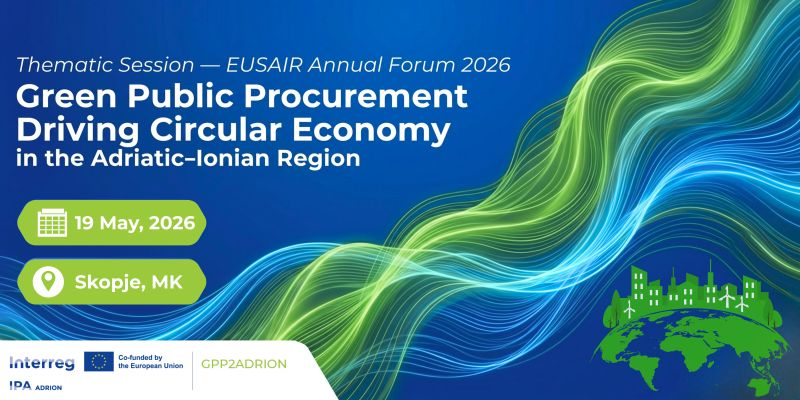
Within the official Forum programme, Circular Change contributed through the GPP2ADRION thematic session: Green Public Procurement Driving Circular Economy in the Adriatic–Ionian Region
The session explored how green public procurement (GPP) can become one of the macro-region’s most effective tools for accelerating circular implementation.
With public procurement representing around 14% of EU GDP, participants highlighted its transformative potential to either reinforce linear economic models or actively accelerate circular, resilient and regenerative solutions across sectors.
Strategic Policy Exchange: from ambition to implementation
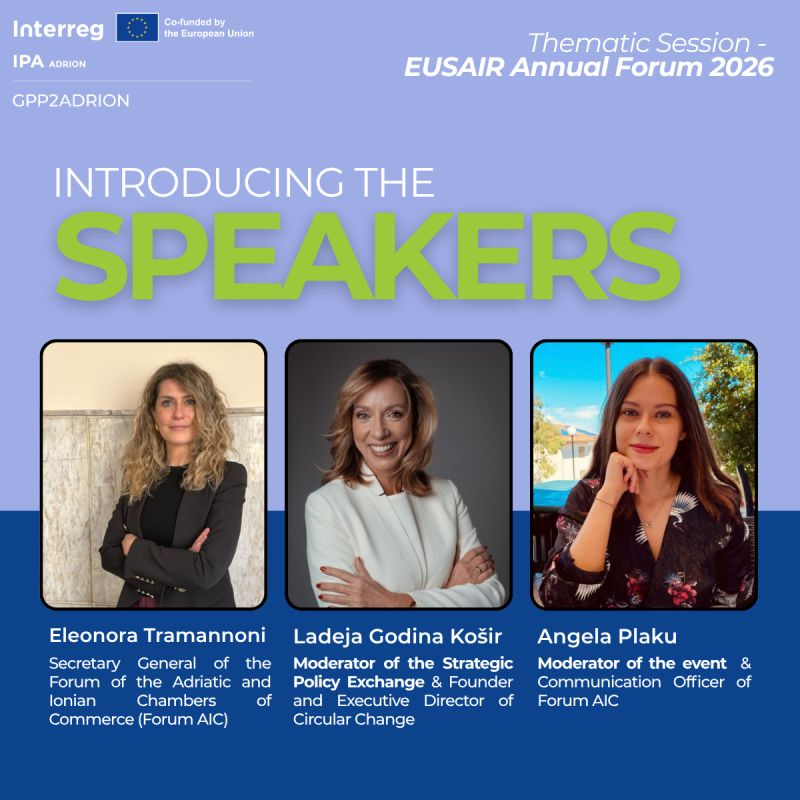
A central highlight of the session was the high-level Strategic Policy Exchange roundtable, moderated by Ladeja Godina Košir.
Bringing together representatives from European institutions, macro-regional governance and implementation partners, the discussion focused on a central question:
How can the Adriatic–Ionian region move from circular policy ambition to coordinated implementation?
The exchange highlighted several priority pathways:
– strengthening institutional implementation capacities
– improving coordination between regional and European governance levels
– advancing transnational cooperation on circular procurement
– recognising procurement as a strategic instrument for resilience and competitiveness
– enabling trusted cross-sector collaboration across the region
The discussion strongly reflected Circular Change’s broader work across Europe: circular transitions scale not through isolated projects, but through ecosystems that connect policy, finance, implementation capacity and trust.
Coinciding with Circular Change’s 10th anniversary year, the Skopje discussions offered a timely reflection on what it takes to turn circular ambition into implementation.