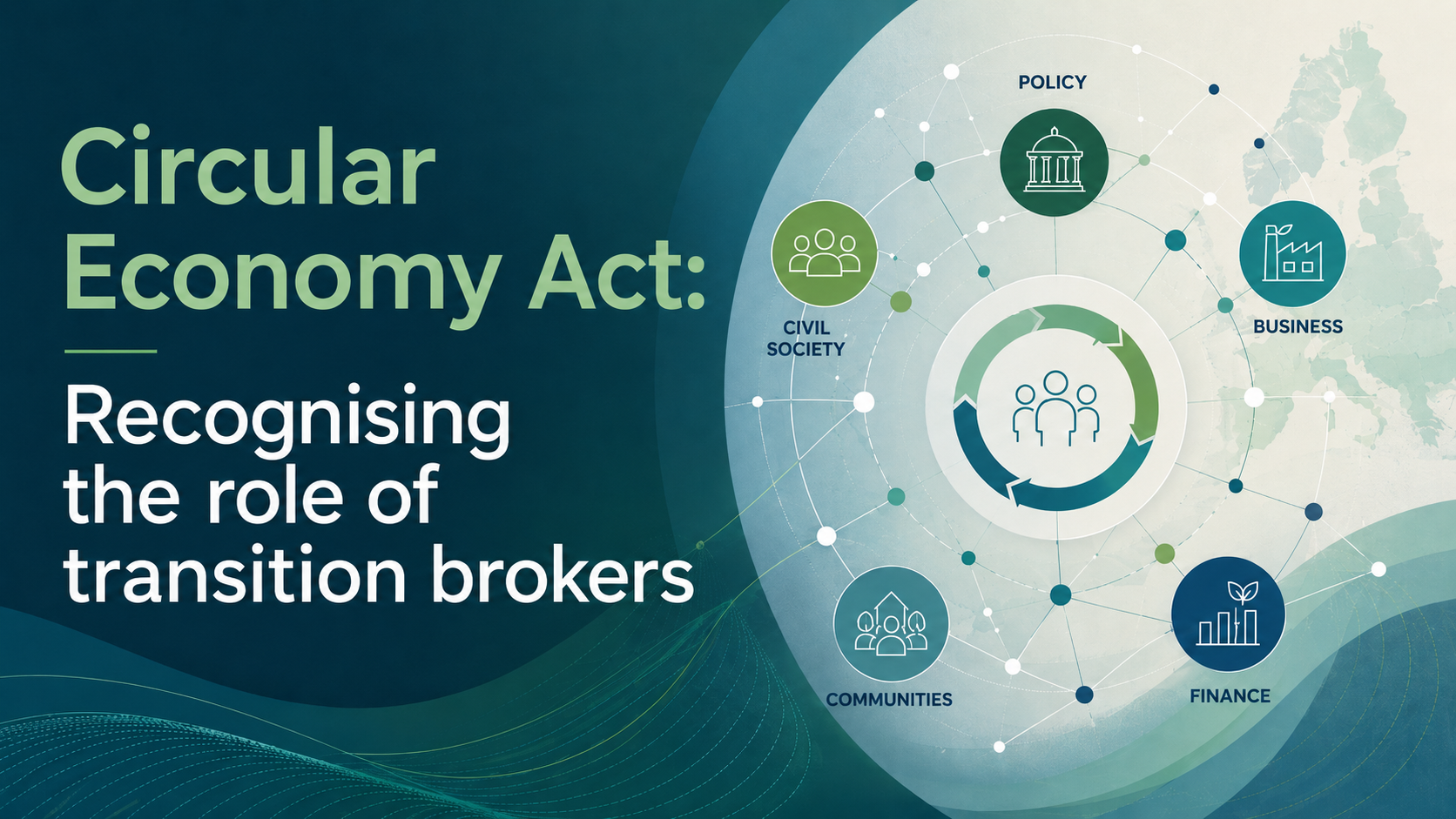
Circular Economy Act: EESC opinion recognising the role of transition brokers
The European Economic and Social Committee has adopted its exploratory opinion Circular Economy Act – Circular economy and responsible resource consumption within planetary boundaries. Prepared at the request of the European Commission, the opinion will feed into the forthcoming EU Circular Economy Act and its ambition to make circularity a horizontal principle for Europe’s competitiveness, resilience and wellbeing.
The opinion was prepared under the leadership of Cillian Lohan, EESC rapporteur for the Circular Economy Act. Ladeja Godina Košir, Founder and Executive Director of Circular Change and Chair of the European Circular Economy Stakeholder Platform Coordination Group, contributed to the process as an advisor.
The EESC opinion calls for a strong and ambitious Circular Economy Act that would provide a coherent framework for circular transition, strengthen markets for secondary raw materials, support circular business models such as reuse, repair and remanufacturing, and advance tools such as traceability, certification, harmonised labelling and technical standards.
A particularly important point is the formal recognition of transition brokers. The opinion stresses that transition brokers must be recognised and resourced to drive circularity across value chains. This reflects a key message continuously highlighted by Ladeja Godina Košir and Circular Change: systemic transformation does not happen by regulation alone. It needs people and organisations capable of connecting fragmented systems, translating complexity into action and supporting stakeholders in moving from strategy to practice.
The opinion also underlines the strategic role of the European Circular Economy Stakeholder Platform as a partner in identifying implementation barriers, aligning priorities, testing indicators and accelerating the circular transition.
Read the EESC opinion: